


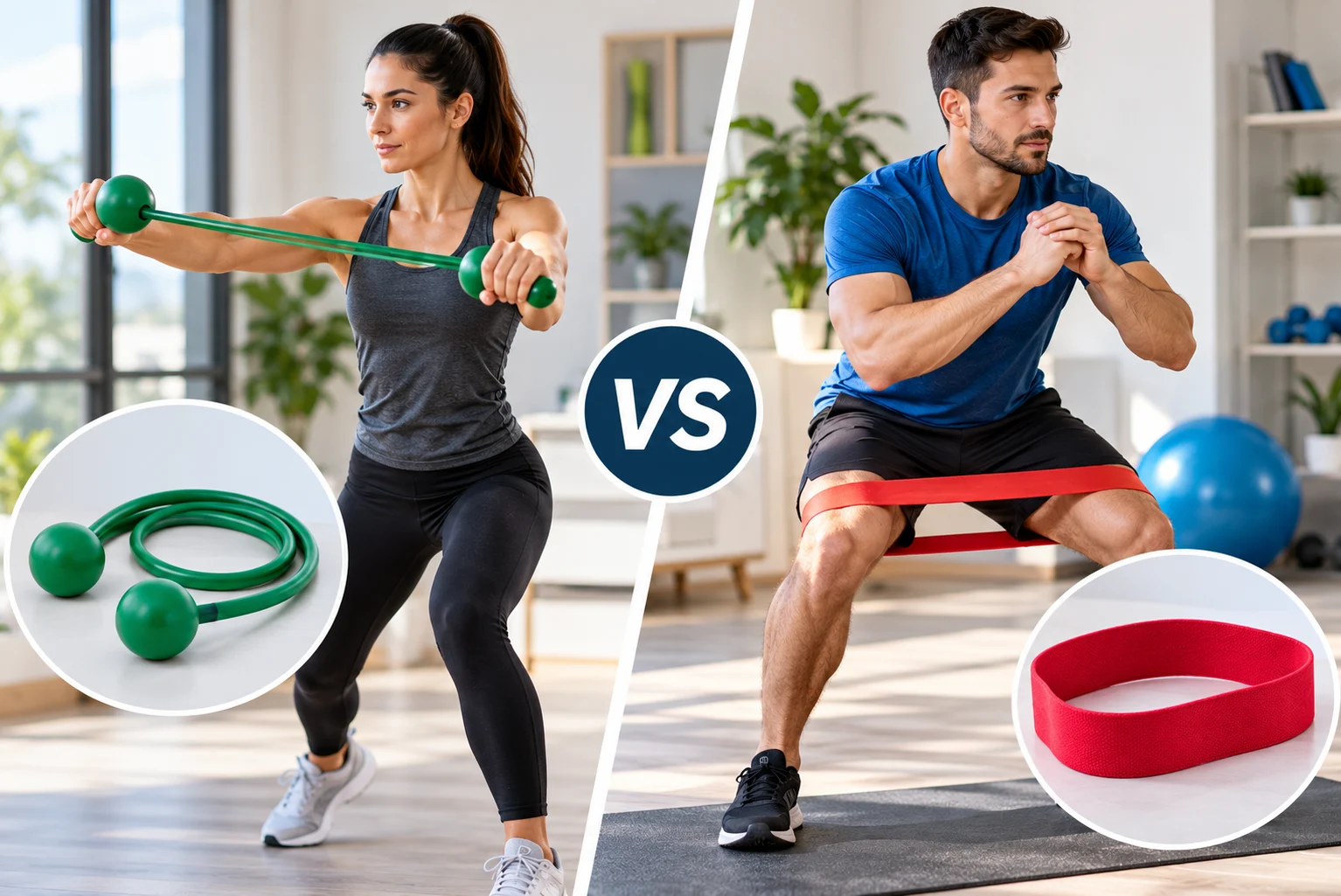
Choosing the right resistance exercise tool can make your workouts more comfortable, versatile, and easier to adapt to your fitness goals. However, not all resistance-based exercise equipment is designed in the same way. Grip style, attachment design, resistance level, and intended exercise movements can all influence which tool works best for your routine.
If you’re comparing Tuball vs Tubelt, both products from TuBallRx offer resistance-based exercise options, but they have different designs and practical uses. Tuball features a ball-grip handle attached to a resistance band, while Tubelt uses a looped resistance design, with certain product variations incorporating belt and ball attachments for different exercise applications.
Understanding these differences can help you make a more informed choice, whether you’re looking for a versatile full-body workout tool, equipment for lower-body conditioning, or a compact option for exercising at home.
In this guide, we’ll compare Tuball and Tubelt by grip, design, exercise applications, resistance options, and suitability for different workout preferences.
What Is Tuball?
Tuball is a resistance-based exercise tool developed by TuBallRx. Its distinguishing feature is a ball-grip exercise tool design, which combines an elastic resistance band with a ball-shaped grip.
According to the TuBallRx website, the ball-grip design is intended to provide control during a range of resistance movements, including exercises involving the arms, shoulders, and legs.
Unlike conventional resistance bands that are commonly held by gripping the band itself or using handles attached at the ends, Tuball incorporates a ball grip as part of its design.
This design supports a variety of movement patterns, depending on the exercise, resistance level, and user’s ability.
Key Features of Tuball
- Ball-grip design: A ball-shaped grip provides an alternative way to hold and control the resistance tool.
- Multiple resistance levels: TuBallRx offers color-coded options, including yellow for very light resistance, green for medium-light resistance, red for medium resistance, and blue for heavy resistance.
- Versatile exercise applications: Tuball is presented as a tool for upper- and lower-body exercise routines.
- Compact design: Its lightweight format makes it suitable for users looking for portable workout equipment.
- Adaptable movement range: The amount of movement and the resistance level can be adjusted to suit the exercise and the user’s capabilities.
Explore the TuBallRx product collection to compare available Tuball resistance options.
What Is Tubelt?
Tubelt is another resistance-based exercise product from TuBallRx, designed around a looped resistance band. The product range also includes variations with belt and ball attachments, allowing users to select equipment according to their preferred exercise applications.
Where Tuball’s key distinguishing feature is its ball grip, Tubelt emphasizes a loop or strap-based design.
The standard Tubelt concept is particularly associated with lower-body exercises involving areas such as the hips, thighs, glutes, and knees. Some TuBeltRX variations are also designed for upper-body workouts or simultaneous upper- and lower-body movements.
Because the range includes different configurations, it’s important to check the specific product rather than assuming every Tubelt model has identical attachments or is intended for the same exercises.
Key Features of Tubelt
- Looped resistance design: Its loop or strap format provides a different way to position and use resistance during exercise.
- Lower-body workout applications: Certain Tubelt products are intended for exercises involving the hips, thighs, glutes, and knees.
- Product variations: The range includes designs such as TuBeltRX Coeval and Trek, as well as upper-body-focused belt-and-ball versions.
- Multiple resistance levels: Color-coded options let users compare resistance levels according to the available product specifications.
- Compact exercise equipment: Tubelt offers a portable option for resistance-based training.
You can explore the TuBeltRX products to compare the available models, resistance levels, and attachments.
Tuball vs Tubelt: Key Differences at a Glance
The following comparison highlights the primary differences to consider when choosing between these two TuBallRx products.
|
Feature |
Tuball |
Tubelt |
| Main design | Resistance band with a ball-grip handle | Looped resistance band or strap-based design |
| Distinguishing feature | Ball-shaped grip | Loop or strap configuration; some models include belt and ball attachments |
| Common exercise applications | Upper- and lower-body resistance movements | Lower-body conditioning, with certain models supporting upper-body or combined workouts |
| Grip and positioning | Uses the ball grip to hold and control the tool | Depends on the loop, strap, belt, and ball configuration of the specific model |
| Resistance choices | Yellow, green, red, and blue options are available | Different resistance levels are available across selected models |
| Best starting point | People who prefer the ball-grip format for versatile resistance movements | People whose exercise preferences match a looped or strap-based resistance design |
| Product selection | Choose according to resistance level and intended exercise | Choose according to resistance level, attachments, and intended exercise |
Neither design is automatically better for every user. The appropriate choice depends on your preferred grip, the movements you plan to perform, and the specific product’s resistance and attachment configuration.
1. Grip Differences: Ball Grip vs Loop or Strap
Grip is an important consideration when choosing resistance exercise equipment because it affects how you hold, position, and control the tool during movement.
Tuball: Ball-Grip Exercise Tool
Tuball incorporates a ball-shaped grip into its resistance-band design. Instead of relying solely on the conventional method of gripping a straight band or a standard handle, users can hold the ball attachment while performing appropriate resistance movements.
This design can be useful for people who prefer a defined gripping point when performing controlled arm, shoulder, or leg exercises.
The ball-grip format also gives Tuball a distinctive identity compared with ordinary resistance bands.
However, a ball grip should not automatically be assumed to be suitable for every hand condition or rehabilitation requirement. Grip comfort depends on the user’s individual needs, and people experiencing pain or recovering from an injury should seek appropriate professional guidance before selecting exercises.
Tubelt: Looped and Strap-Based Design
Tubelt uses a different approach. Its looped resistance format is associated with lower-body exercise applications, while particular TuBeltRX products incorporate additional belt and ball attachments.
This allows the product range to support different ways of positioning the resistance equipment.
For example, a model designed for lower-body workouts may suit a different movement pattern from an upper-body-focused belt-and-ball model.
Before choosing a Tubelt product, review its product description to determine which attachments are included and which exercises the model is designed to accommodate.
The main distinction: Tuball centers on the ball-grip handle, whereas Tubelt emphasizes the loop or strap configuration and the exercise applications of its specific model.
2. Design Differences and Resistance Options
The physical design of an exercise tool influences how it can be incorporated into a workout. Tuball and Tubelt therefore offer different starting points for resistance-based training.
Tuball’s Design
Tuball combines an elastic resistance band with a ball grip. Its product range offers color-coded resistance choices, making it possible to compare lighter and heavier options.
The yellow Tuball provides very light resistance, while the green, red, and blue versions represent progressively different resistance categories according to the product range.
When selecting a Tuball product, consider the exercises you intend to perform and your ability to control the movement throughout its range.
A higher resistance level is not necessarily the best starting point. Choose equipment that allows you to maintain appropriate control and follow the intended exercise technique.
Tubelt’s Design
Tubelt’s looped or strap-based format offers a different method of positioning resistance. Some models focus on lower-body exercise, while variations with belt and ball attachments offer other workout configurations.
The TuBeltRX Coeval and Trek collections provide examples of these product variations. Their names, resistance categories, and attachment configurations should be checked on the individual product pages before purchase.
Because not all Tubelt products serve the same purpose, choosing a specific design is just as important as choosing its resistance level.
For a quick comparison, begin with the Tuball and Tubelt product range and examine the descriptions of the individual models.
3. Exercise Uses: Which Tool Fits Your Routine?
The practical difference between Tuball and Tubelt becomes clearer when you consider the types of movements you want to perform.
Upper-Body Exercises
Tuball’s ball-grip design can be incorporated into appropriate resistance movements involving the arms and shoulders. Depending on the exercise and the user’s capabilities, these movements may form part of a broader upper-body routine.
Tubelt also has upper-body-focused product variations. Certain TuBeltRX models feature belt and ball attachments and are marketed specifically for upper-body exercise.
If your goal is upper-body training, compare the grip format and attachments rather than assuming that one entire product family is exclusively for the upper body.
Lower-Body Exercises
Lower-body conditioning is a particular use case for Tubelt’s looped resistance design.
Depending on the selected product and exercise, resistance-based movements may involve the hips, thighs, glutes, and knees.
Tuball can also be used for suitable leg exercises, so choosing between the products depends on your intended movements and preferred equipment format.
If you’re specifically looking for lower-body resistance equipment, begin by examining the Tubelt models designed for that purpose.
Full-Body Workouts
Both product families can contribute to resistance-based exercise routines, although their precise applications depend on the model.
Tuball’s ball-grip format is presented as suitable for upper- and lower-body movements. Some TuBeltRX belt-and-ball products are designed to engage several muscle groups during a workout.
The practical approach is to plan your workout first, then select a tool whose grip, attachments, and resistance level suit the movements involved.
A tool that matches your exercise routine and can be used with appropriate control is more useful than simply choosing the product with the highest resistance.
4. Can Tuball and Tubelt Be Used for Rehabilitation Exercises?
TuBallRx describes both product families as suitable for selected resistance-based mobility and rehabilitation exercises. The company’s FAQs page discusses their use for controlled range-of-motion movements and related exercise applications.
However, rehabilitation requirements vary considerably. An exercise that is appropriate for one person may not be suitable for another, particularly following surgery or a muscle or joint injury.
If you are considering these products as part of rehabilitation, consult your physiotherapist or other qualified healthcare professional about the appropriate equipment, resistance level, movement range, and exercise technique.
Neither product should be assumed to diagnose, treat, or cure an injury or medical condition. Use the equipment according to the product instructions and the advice of an appropriate professional.
5. How to Choose Between Tuball and Tubelt
If you’re still unsure which product to choose, consider these questions before buying.
Choose Tuball as your starting point if:
- You prefer a resistance tool with a ball-grip handle.
- You want to explore suitable upper- and lower-body resistance movements.
- You want to compare different color-coded resistance levels.
- You value a compact exercise tool with a distinctive grip design.
Explore Tubelt if:
- You prefer a looped or strap-based resistance format.
- Your routine includes lower-body conditioning.
- You want to compare models with different belt and ball attachments.
- You need a particular configuration for upper-body or combined upper- and lower-body workouts.
These are starting points rather than rigid rules. The most appropriate option is the one whose design, resistance level, and intended use fit your actual exercise needs.
Before purchasing, compare the individual product descriptions, available resistance levels, included attachments, and exercise demonstrations.
6. Where to Buy Tuball and Tubelt
TuBallRx provides an online collection of resistance-based exercise products, including Tuball and TuBeltRX variations.
If you’re comparing Tuball vs Tubelt, start with the design difference that matters most to you: a ball-grip handle or a looped and strap-based configuration.
Then compare the specific resistance level, intended exercise applications, and attachments included with each model.
Visit the official TuBallRx website to explore the available products and find the model that best matches your workout preferences.
Final Thoughts: Tuball vs Tubelt
The choice between Tuball and Tubelt comes down to grip, design, attachments, and the movements you want to perform.
Tuball’s ball-grip exercise tool design provides a distinctive way to hold and control resistance during suitable movements. Tubelt’s looped or strap-based configuration offers different applications, particularly for lower-body conditioning, with selected models designed for upper-body or combined workouts.
Before making a decision, compare the specific products rather than relying only on their names. Consider the resistance level, exercise requirements, included attachments, and your comfort using the equipment.
Ready to explore your options? Visit TuBallRx to compare Tuball and Tubelt products and find the resistance exercise tool that fits your routine.
FAQs
What is the main difference between Tuball and Tubelt?
Tuball features a ball-grip handle attached to a resistance band. Tubelt uses a looped or strap-based resistance design, with certain models including belt and ball attachments. The products differ in grip, configuration, and intended exercise applications.
Is Tuball better than Tubelt?
Neither product is universally better. Tuball may appeal to people who prefer a ball-grip exercise tool, while Tubelt may suit people looking for a looped or strap-based configuration. Your exercise goals, grip preference, and the individual product specifications should guide your choice.
Can Tuball and Tubelt be used for full-body workouts?
Both product families can support selected resistance exercises. Tuball is marketed for upper- and lower-body movements, while certain Tubelt models are designed for combined upper- and lower-body workouts. The precise exercises depend on the product and your capabilities.
Which product is better for lower-body resistance exercises?
Tubelt is specifically associated with lower-body workouts involving areas such as the hips, thighs, glutes, and knees. However, Tuball can also be used for appropriate leg exercises. Check the specific model and intended exercise applications before choosing.
Are Tuball and Tubelt available in different resistance levels?
Yes. TuBallRx offers color-coded Tuball options, including yellow, green, red, and blue resistance categories. Tubelt also has different resistance levels across its product range. Always check the individual product listing for its specified resistance category.
Can beginners use Tuball or Tubelt?
Both product families offer options intended for different fitness levels. Beginners should select an appropriate resistance level, follow the product instructions, and focus on controlled technique rather than choosing resistance based solely on its color or intensity.
Are Tuball and Tubelt suitable for physical therapy?
TuBallRx describes both products as suitable for selected rehabilitation and range-of-motion exercises. However, suitability depends on the person’s condition and prescribed movements. Consult a qualified healthcare professional before using resistance equipment during injury recovery.
Where can I compare Tuball and Tubelt products?
You can compare the available models, descriptions, resistance levels, and attachments through the official TuBallRx online store.