
Starting a fitness routine doesn’t require an expensive gym membership, heavy weights, or complicated equipment. If you’re new to exercise, a low-impact full-body workout at home can be a practical way to build an exercise habit, move your body regularly, and gradually develop strength without relying on jumping or other high-impact movements.
With simple exercises and portable workout equipment, you can work your arms, shoulders, back, core, hips, and legs in one session. Resistance bands are particularly useful because they offer adjustable exercise challenges through movement range, positioning, and the resistance level you choose.
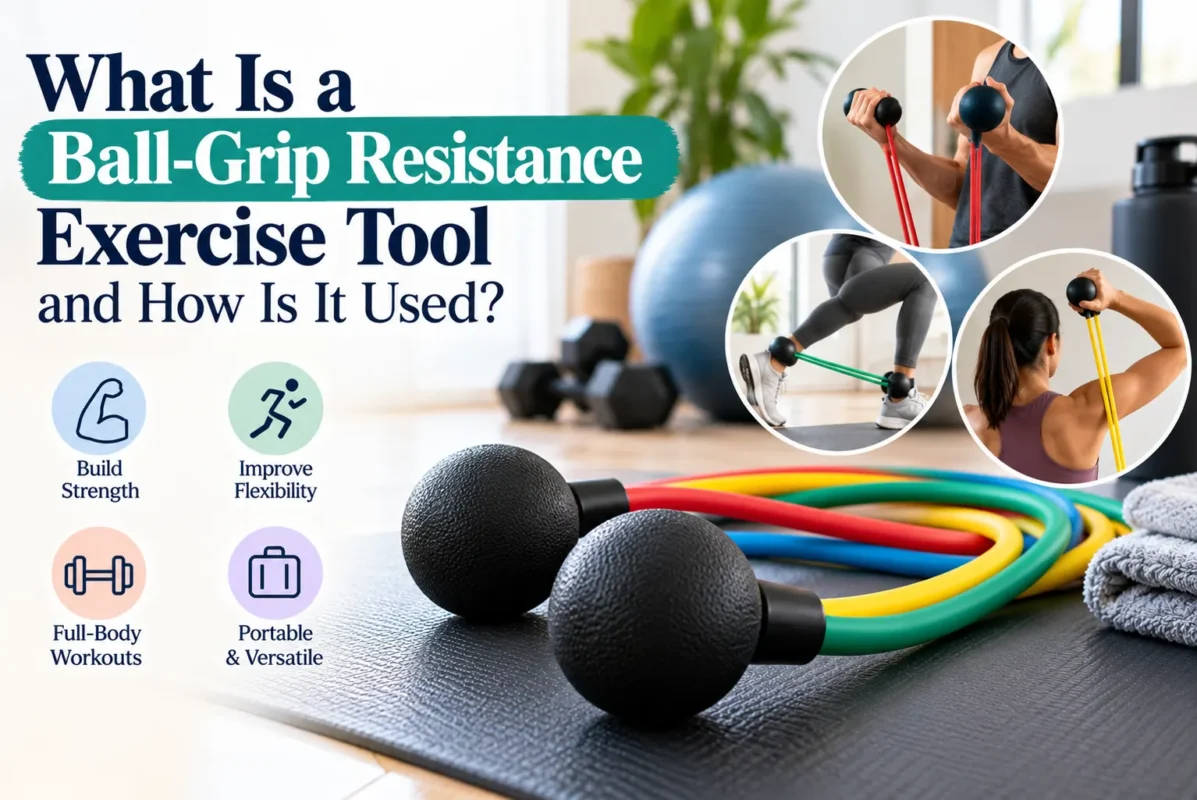
At TuBallRx, we offer compact, resistance-based exercise tools designed for a variety of movements. The Tuball features a ball-shaped grip attached to an elastic resistance band, providing an alternative grip for resistance exercises. This design makes it an option worth exploring if you’re looking to add variety to your home fitness routine.
In this guide, you’ll learn how to build a beginner resistance routine, which exercises to try, how to choose your resistance level, and how to make your workouts manageable and consistent.
What Is a Low-Impact Full-Body Workout?
A low-impact full-body workout combines exercises that target multiple major muscle groups without requiring repetitive jumping or forceful landings.
Unlike high-impact routines that may include jump squats, burpees, and running drills, low-impact exercise can involve controlled movements such as squats, standing rows, arm curls, and gentle marching.
A full-body routine generally includes movements for:
- Arms and shoulders: Curls, shoulder movements, and controlled extensions.
- Back and chest: Resistance rows and appropriate pushing movements.
- Core: Abdominal bracing and controlled standing movements.
- Hips and legs: Chair squats, calf raises, and supported leg movements.
- General mobility: Comfortable movements that help you prepare for exercise and transition between exercises.
Low-impact does not necessarily mean easy. A carefully selected resistance level and controlled repetitions can make a workout challenging without requiring high-impact movements.
The best approach for beginners is to start with manageable exercises, prioritize technique, and increase the difficulty gradually.
Benefits of a Beginner Resistance Routine
A beginner resistance routine can help you establish a structured approach to exercise without overwhelming yourself.
1. Work Multiple Muscle Groups
A well-planned session can include upper-body, lower-body, and core exercises. This allows you to work several major muscle groups without needing a separate workout for every body part.
2. Build Consistency at Home
Working out at home removes the need to travel to a gym. You can schedule a short session around your daily responsibilities and adjust the routine to suit your current ability.
3. Progress Gradually
Resistance exercises can be modified by changing the resistance level, movement range, repetitions, or exercise variation. Beginners can start with comfortable movements and progress as their control and confidence improve.
4. Use Compact, Portable Workout Equipment
Portable workout equipment is convenient when you have limited space or want to exercise while traveling. Resistance bands are generally lightweight and easier to store than many traditional gym machines.
TuBallRx offers resistance-based exercise products designed for home and gym use. Its Tuball range includes color-coded resistance options and a distinctive ball grip. Explore the available products through the official TuBallRx website.
What Equipment Do You Need?
You don’t need a fully equipped home gym to get started. Prepare the following items before beginning your workout:
- A stable chair for supported exercises.
- Enough clear floor space to move your arms and legs comfortably.
- Comfortable clothing and supportive footwear, if appropriate for your exercises.
- Water to stay hydrated.
- A resistance band or resistance-based exercise tool, if you want to include resistance training.
Why Consider TuBallRx?
TuBallRx develops resistance-based exercise tools intended for full-body movements. The Tuball features an elastic resistance band with a ball-shaped grip, offering an alternative to holding a conventional band directly.
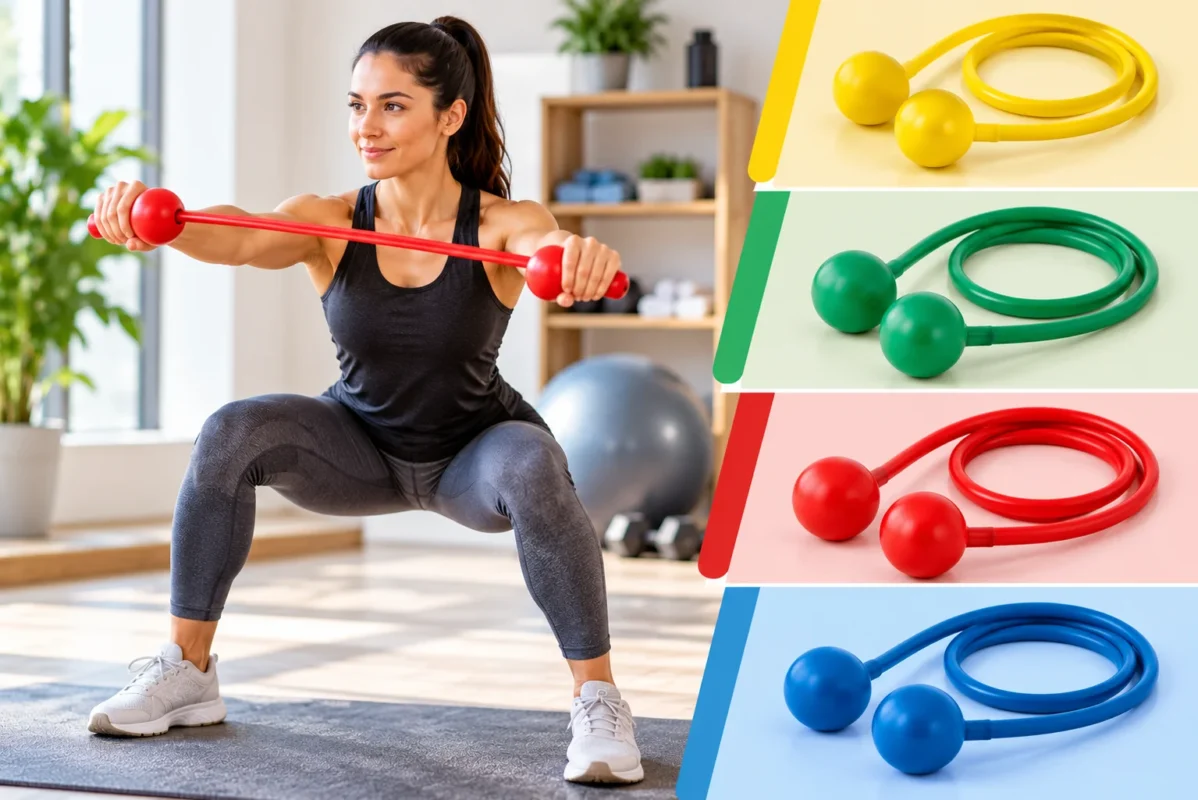
The website lists four color-coded Tuball resistance options:
- Yellow: Very light resistance.
- Green: Medium-light resistance.
- Red: Medium resistance.
- Blue: Heavy resistance.
Beginners may prefer to explore yellow or green, depending on the movement and their current ability. However, the color alone does not determine which option is appropriate for every exercise.
Learn more about the available options through the TuBallRx resistance-level guide.
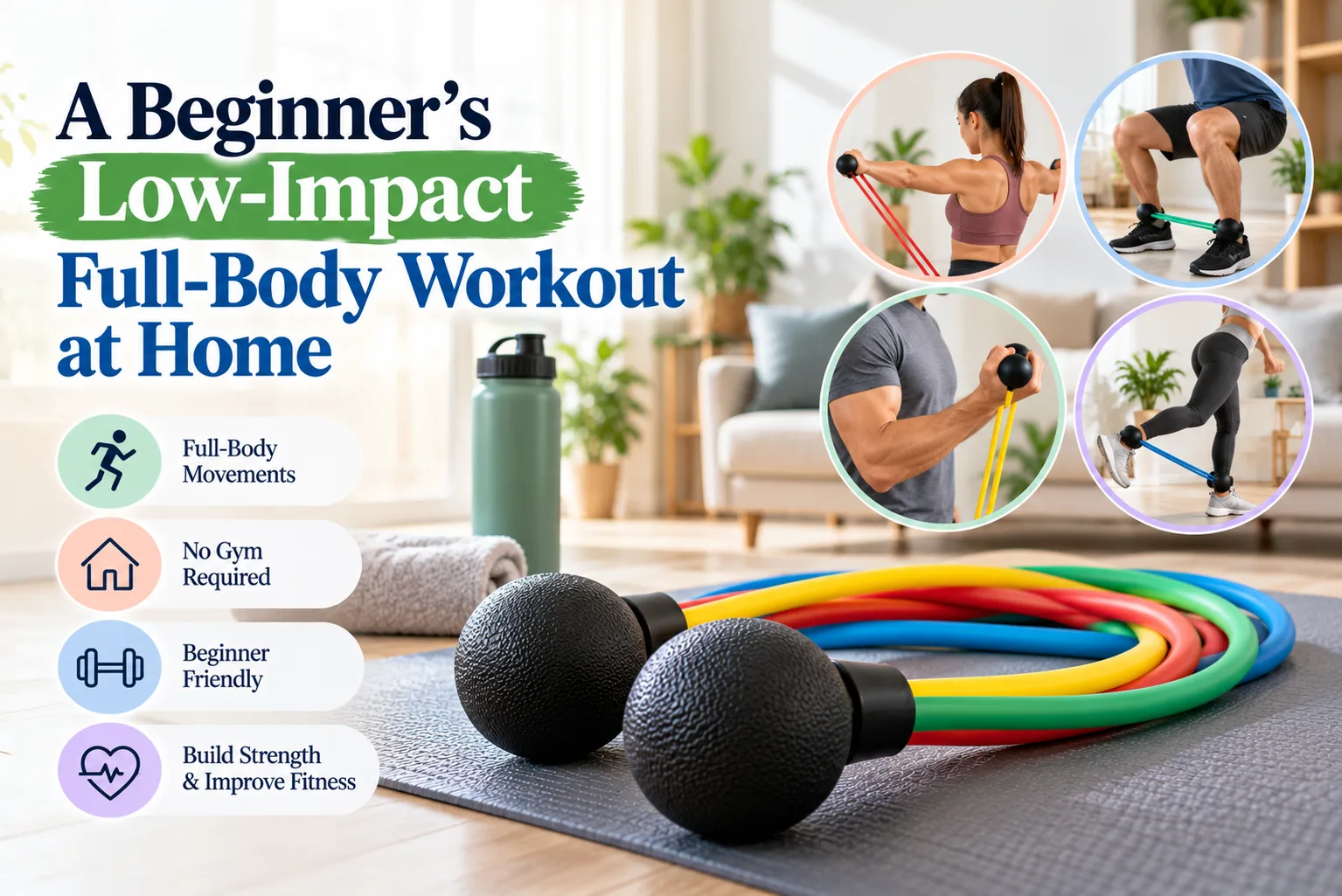
A Beginner’s Low-Impact Full-Body Workout at Home
The following routine combines simple bodyweight movements with optional resistance exercises. It is designed as a general starting point rather than an individualized training prescription.
Suggested structure:
- Warm-up: 5 minutes.
- Main workout: Approximately 15–20 minutes.
- Cool-down: 3–5 minutes.
- Frequency: Start with two sessions per week, adjusting according to your comfort and recovery.
Move at a pace that allows you to maintain control. Rest whenever necessary.
1. Gentle Marching in Place
Target areas: Legs and general cardiovascular conditioning.
How to do it:
- Stand with your feet approximately hip-width apart.
- March gently in place, lifting one foot at a time.
- Swing your arms naturally if comfortable.
- Continue at a steady, manageable pace.
Suggested duration: 60 seconds.
Beginner tip: Hold a stable chair for support if needed. Keep your steps small and avoid rushing.
2. Chair Squats
Target areas: Thighs, hips, and glutes.
Chair squats help beginners practice a controlled sitting and standing movement.
How to do it:
- Place a stable chair behind you.
- Stand with your feet about shoulder-width apart.
- Bend your knees and move your hips backward as though sitting down.
- Lightly touch the chair or sit down with control.
- Push through your feet to return to standing.
Suggested repetitions: 8–10.
Beginner tip: Use your hands for support if needed. Only lower yourself as far as feels comfortable.
3. Standing Resistance Rows
Target areas: Upper back, shoulders, and arms.
A standing row is a useful full-body resistance exercise component because it trains pulling movements in the upper body.
How to do it:
- Follow the equipment’s instructions for positioning and holding the resistance tool.
- Begin with your arms in a comfortable starting position.
- Pull your elbows backward while keeping your shoulders relaxed.
- Pause briefly without shrugging.
- Return to the starting position slowly.
Suggested repetitions: 8–10.
Beginner tip: Use a resistance level that allows you to move smoothly. Do not jerk the band or force your elbows backward.
Only perform this movement with an appropriate setup for your equipment. Do not wrap an elastic band around your hands or body unless the manufacturer specifically instructs you to do so.
4. Standing Biceps Curls
Target areas: Biceps and forearms.
How to do it:
- Set up your resistance equipment according to its instructions.
- Begin with your elbows close to your sides.
- Bend your elbows to bring your hands toward your shoulders.
- Keep your shoulders relaxed.
- Lower your hands slowly to the starting position.
Suggested repetitions: 8–10.
Beginner tip: Avoid swinging your upper body to complete a repetition. Reduce the resistance or shorten the movement if you cannot maintain control.
5. Controlled Standing Leg Extensions
Target areas: Front thigh muscles.
How to do it:
- Stand behind a stable chair and hold it for balance.
- Keep your torso upright.
- Slowly straighten one knee to move your foot slightly forward.
- Return to the starting position.
- Repeat on the other leg.
Suggested repetitions: 8 per leg.
Beginner tip: Start without resistance. Keep the movement small and comfortable rather than locking your knee forcefully.
6. Standing Calf Raises
Target areas: Calf muscles and lower-leg strength.
How to do it:
- Stand behind a stable chair.
- Keep your feet approximately hip-width apart.
- Slowly lift your heels from the floor.
- Pause briefly at the top.
- Lower your heels with control.
Suggested repetitions: 10–12.
Beginner tip: Hold the chair for balance and avoid bouncing. You do not need to lift your heels as high as possible.
7. Standing Resistance Press or Extension
Target areas: Depending on the variation, the chest, shoulders, or arms.
The exact movement depends on your equipment and its intended use. Choose a press or extension exercise demonstrated in the manufacturer’s instructions rather than improvising an unfamiliar band setup.
How to approach it:
- Follow the equipment instructions for the selected movement.
- Begin with a comfortable range of motion.
- Move slowly while maintaining a stable posture.
- Return to the starting position without allowing the resistance to pull your arms abruptly.
Suggested repetitions: 8–10, provided you can perform the movement comfortably and correctly.
Beginner tip: Skip this exercise if you are unsure how to position the equipment. A qualified trainer can help you learn the movement.
8. Gentle Standing Core Brace
Target areas: Core muscles.
How to do it:
- Stand comfortably with your feet hip-width apart.
- Keep your shoulders relaxed.
- Gently tighten your abdominal muscles as if preparing for a light cough.
- Continue breathing normally.
- Hold the contraction for several seconds, then relax.
Suggested repetitions: 5–8 controlled holds.
Beginner tip: Do not hold your breath or pull your stomach in forcefully.
9. Gentle Cool-Down
Finish with a few minutes of relaxed walking in place and comfortable shoulder, arm, and calf movements.
Avoid forcing a stretch or bouncing at the end of your range of motion. Stop any movement that causes pain or unusual discomfort.
How to Choose the Right Resistance Level
Choosing appropriate resistance is an important part of a sustainable beginner workout.
TuBallRx offers the following color-coded options:
| Tuball color | Resistance category | General consideration |
| Yellow | Very light | Worth considering when beginning with gentle resistance movements. |
| Green | Medium-light | May suit beginners who can comfortably control a moderate challenge. |
| Red | Medium | An option for movements requiring a greater resistance challenge. |
| Blue | Heavy | Intended for exercises where a higher resistance level is appropriate. |
Your starting point should depend on the exercise, your current ability, and how comfortably you can control the movement. You do not need to progress to a stronger resistance level on a fixed schedule.
Explore the yellow very-light TuballRx or the green medium-light TuballRx to compare beginner-oriented options.
Choose a resistance level that lets you complete repetitions without jerking, twisting, or relying on momentum.
Tips for Making Your Home Workout Consistent
The most effective beginner routine is one you can maintain.
- Start small: You do not need to complete every exercise on your first day. Begin with a few movements and gradually add others as you become more comfortable.
- Prioritize technique: Controlled repetitions are more useful than rushing through a long list of exercises with poor form.
- Schedule your sessions: hoose realistic times during the week and treat them as planned appointments.
- Keep your equipment accessible: Compact equipment can make it easier to prepare a workout space without rearranging an entire room.
- Track your progress: Record the exercises you perform, the repetitions completed, and how comfortable the movements feel. Increase difficulty gradually when the current routine becomes manageable.
- Allow recovery: Rest between sessions and adjust the routine if you feel unusually fatigued.
If you have a health condition, balance limitations, persistent pain, or are recovering from an injury or surgery, seek guidance from a qualified healthcare professional before starting or changing a resistance-training routine.
Make TuBallRx Part of Your Home Fitness Routine
Building a home workout routine does not have to involve bulky machines or complicated exercises. A combination of bodyweight movements and carefully selected resistance exercises can help beginners create a practical fitness habit.
TuBallRx offers compact resistance-based tools designed for different resistance preferences and exercise applications. Its Tuball ball-grip design provides an alternative way to hold a resistance exercise tool, while its color-coded options make it easier to compare resistance categories.
Whether you are exploring a beginner resistance routine or looking for portable workout equipment, choose movements that suit your ability and prioritize controlled technique.
Ready to explore your options? Visit the official TuBallRx website to discover the available products and find a resistance option that fits your workout preferences.
Start with manageable movements, progress at your own pace, and focus on building a consistent routine.
FAQs
What is a low-impact full-body workout at home?
A low-impact full-body workout at home combines exercises for the upper body, core, hips, and legs without relying on repetitive jumping or forceful landings. It can include chair squats, standing calf raises, controlled arm movements, and resistance exercises.
How often should a beginner exercise at home?
A beginner can start with two manageable workout sessions per week and adjust according to comfort, recovery, and individual circumstances. Gradually build consistency rather than increasing workout frequency too quickly.
Do I need equipment for a beginner resistance routine?
No. Many beginner exercises use bodyweight alone. However, resistance bands and other portable workout equipment can provide additional exercise options when used according to the manufacturer’s instructions.
Which TuBallRx resistance level is suitable for beginners?
Yellow offers very light resistance, while green offers medium-light resistance. Either may be worth considering depending on the exercise and your current ability. Choose the option you can control comfortably and review the TuBallRx resistance-level guide before deciding.
Can resistance bands be used for a full-body resistance exercise routine?
Yes. Depending on the equipment and exercise variations, resistance bands can be used for movements targeting the arms, shoulders, back, hips, and legs. Select suitable exercises and maintain controlled movement throughout each repetition.
Is low-impact exercise suitable for older adults?
Some older adults may find appropriately modified low-impact exercise useful for maintaining physical activity. The right exercises depend on individual mobility, balance, and health circumstances. Anyone with relevant health concerns should consult a qualified healthcare professional before starting.
What makes TuBallRx different from a conventional resistance band?
TuBallRx Tuball products feature a ball-shaped grip attached to an elastic resistance band. This provides an alternative grip for selected resistance movements. The product range also includes color-coded resistance options for different exercise preferences.
Where can I buy TuBallRx workout equipment?
You can explore available TuballRx products and resistance options on the official TuBallRx website. Review each product’s description and instructions to determine whether it fits your intended workout.